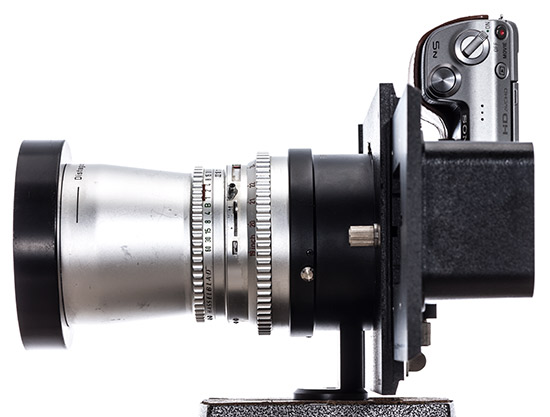
Sony NEX-5N with a Hasselblad 50mm Distagon via RhinoCam Photo by PCMag"
The RhinoCam allows us to use NEX E-mount cameras with medium format lenses. The RhinoCam has lens adapters for Pentax 645, Mamiya 645, or Hasselblad V lenses. The NEX is mounted on a shift mount while the lens is fixed. The NEX is then shifted to cover the image circle projected by the medium format lens. Each image is then stitched by an imaging software.
Here's an in-depth video walk through of the RhinoCam.
Here are some sample shots from the NEX-7 and the Contax Zeiss 28mm f/2.8 Distagon using the Metabones Speedbooster. It was great shooting the 28mm at close to its natural focal length. The lens was always set wide open at f/2.8 and the NEX-7 was at ISO 100. We are very pleased with the Speed Booster.
Here's a nice feature of the upcoming Fuji X100s that we'd like to see in a future NEX camera. They are using the PDAF sensor to create a digital split image to mimic classic manual focus slrs and rangefinders. You can also see that they've finally included focus peaking to one of their cameras. All NEX cameras include focus peaking since June 2011.
It looks like Sony is still massaging the Sony DSC-RX1 features. The RX1's top shutter speed has been raised to 1/4000 sec when the aperture is f/5.6 or smaller on the Carl Zeiss 35mm Sonnar lens. The shutter speed is 1/2000s when the lens aperture is larger than f/5.6 down to f/2.
Zeiss 35mm Sonnar's 9 Aperture Blades Create a Circular Shape
The other revision to the RX1 is the focus wheel on the front of the camera. The production RX1 will let you select from Autofocus (AF), Direct Manual Focus (DMF), and Manual Focus (MF). DMF Mode allows the user to fine tune AF by adjusting the manual focus ring on the lens after the RX1 has locked focus.
Focus Wheel Changed on Sony RX1
We found a few more images of some DSC-RX1 accessories.
What Comes with the FDA-V1K Zeiss 35mm Optical Viewfinder
RX1 Thumbgrip TGA-1 Swings Open to Access Buttons
Here is a new sample image from the Sony RX1. Click for the full 24 mp, 6000x4000 pixel image.
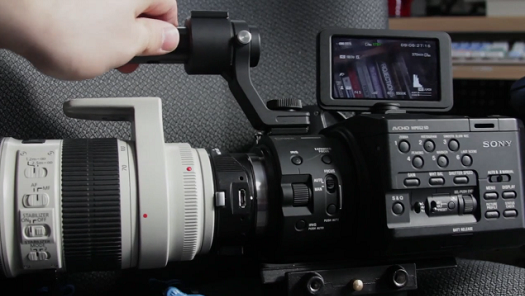
Bryant N. posted his review of the Conurus EOS Smart Adapter for NEX cameras. He was impressed with the build quality, the lens release mechanism, complete control of EOS lenses by the NEX-FS100 Super 35 Camcorder, and EOS image stabilization powered by the NEX. He found a couple of bugs that were easily solved. The best part for us was the IS testing - it looks like Conurus has a winner on their hands.
Testing EOS Image Stabilization (IS) with the NEX-FS100 NXCAM
The button on the adapter is a Wide Open button to ease manual focusing. It's called the depth of field (DOF) preview button in the video.
See our previous post about the Conurus EOS smart NEX lens adapter for more info.
We were lucky enough to get nice seats to the New Jersey Devils vs Anaheim Ducks. We brought the NEX-5 with a Minolta MD/SR to NEX/E-mount lens adapter the Minolta 45mm f/2 MD Rokkor-X. The combination easily fits into a jacket pocket.
The 45mm f/2 on the NEX gives an equivalent FOV of 67.5mm, which allowed us to shoot the width of the ice from our seats. Here are a few shots from the night. Most of these are cropped which shows the lens' and NEX sensor capability.
Helical Mount Leica M to E-mount Lens Adapter Extended
Helical Mount Leica M to E-mount Lens Adapter Retracted
Hawk's Factory has produced a Leica M lens adapter for the NEX E-mount that incorporates a helicoid. The helical mount, when retracted, places the Leica M lens at the correct flange focal distance from the NEX's APS-C sensor to achieve infinity focus. At minimum focus distance (MFD), the lens can be moved further away from the sensor by using the helicoid, acting like a macro extension tube. This will allow for focusing closer than the lens' native MFD.
The Helicoid Leica M to NEX E-mount Lens Adapter was tested on several lenses and here are the outcomes:
SUMMILUX 50/1.4 V1: MFD 1 meter, with adapter 0.43 m
SUMMICRON 50/2 V5: MFD 0.75 m, with helicoid adapter 0.38 m
HEKTOR 73/1.9: MFD 1.2 m, with helicoid adapter 0.73 m
SUMMICRON 90/2 V3: MFD 1 m, with helicoid adapter 0.73 m
Rangefinder shooters know that MFD is one of the drawbacks of using rangefinder lenses and Hawk's Factory has come up with a nice solution. Hawk's Factory can be found on eBay.
Macro extension tubes for the NEX E-mount are finally available. Macro tubes move the lens farther away from the sensor which allows for closer focusing which means higher magnification of the image. The tubes are hollow and have no optical elements to degrade the image.
The current NEX macro tubes do not have electrical contacts, therefore the 16mm Pancake, 18-55mm OSS Zoom, and the 18-200mm OSS Zoom lenses will not work with the macro tubes. Adapted lenses will work great with them, NEX-C3 to Macro Tubes to E-mount lens adapter to adapted lens.
This will be very helpful for rangefinder lenses and their large minimum focus distance (MFD).
The links include instructions on performing a firmware upgrade on your Sony NEX Camera. Charge you battery to 100% status and read the instructions at least twice then perform the firmware upgrade.
Here is the Sony NEX-C3 with a manual focus Jupiter-9, 85mm f/2 lens. The NEX-C3 comes with firmware upgrade 04 and will have the focus peaking feature. As the lens' focus ring is moved from minimum focus distance (MFD) towards infinity, the LCD screen of the NEX shows red highlights or peaking. The red highlights indicate greatest sharpness. Watch as the green leaves edges turn red and as the ring is brought back towards MFD the features of the Rolleiflex Twin Lens Reflex (TLR) camera turn red as they come into focus.
This is great news for NEX users who enjoy using adapted manual focus lenses. The use of manual focus aid, zooming in at 7.5x and 15x, can be eliminated for casual focus. 7x and 14x zoom can still be useful for very critical focus. This will mean quicker captures.
Frame, focus, shoot; instead of 7.5x zoom, move focus point, focus, exit to frame, frame, and shoot.
We think that this feature will influence other manufacturers to incorporate peaking in their digital cameras to ease manual focusing.
Firmware upgrade 04 for Sony NEX-3, and NEX-5 cameras will be available for download on June 20th - we will have more information and tests on focus peaking shortly after.
The red edges, peaking, of the camera strap indicates greatest sharpness.
whatdigitalcamera is nice enough to share a hands on video of the new Sony NEX-C3. You can see how much smaller the NEX-C3 is compared to the old NEX-3. The video also shows the new HVL-F20S flash for the NEX system.
We can also see the new focus peaking feature of the new FIrmware 04, available later this month, the 20th. Focus peaking highlights the image to show what is in focus. This is great help for using manual lenses on the NEX system.
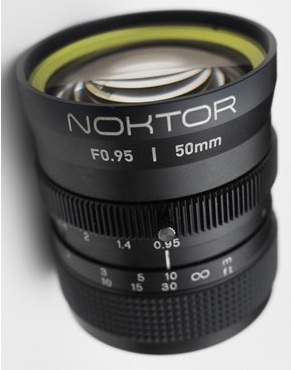
Here is the SLR Magic x Noktor HyperPrime 50mm F0.95 for the Sony NEX E-mounhttp://www.blogger.com/img/blank.gift. That is correct the maximum aperture is 0.95 similar to that of the very rare Leica 50mm Noctilux-M priced at $10,495. The Noktor is priced at $1000 which is very close to the Voigtlander 50mm f/1.1 Nokton. This fully manual lens, with an FOV of 75mm on the NEX, will allow plenty of light onto the sensor for low light shooting.
We are waiting for sample photos to see how this lens from the new Noktor company performs, recently acquired by SLR Magic.
Here is a generic Leica M to Sony NEX E-mount lens adapter. The adapter allows for infinity focus but it occurs before the infinity mark. We wanted to get closer to the infinity mark so we took off the (4) screws that attach the silver part to the black part. We used a precision slotted screwdriver and made sure not to strip the very tiny screws.
We used pieces of aluminum foil to add thickness to the adapter. This will get the Leica M lens farther away from the Sony NEX sensor and infinity focus should be closer to the infinity mark on the lens. If the foil is too thick, the lens will be too far away and infinity focus may not be achieved.
Reassemble the adapter and test the lens for infinity focus.
Sony NEX-5 with a 1920s Sirene 135 9x12 cm large format camera
Face emailed us with an interesting contraption. He had a Sirene 135, with a 13 cm lens and maximum aperture of f/8, that was collecting dust and a new Sony NEX-5. He cut a hole in the back of the Sirene 135 and attached an E-mount lens cap to it. The NEX-5 now functions as a digital back for this large format camera made between 1914 and 1926.
Face tells us that focusing is quite difficult since the lens needs plenty of light with a maximum aperture of f/8. He sets the NEX shutter at 4 seconds and uses the Sirene 135's shutter mechanism to take the shot. Amazing for a camera almost 100 years old.
The NEX sensor size is 23.4 x 15.6 mm which is more than 5 times smaller than the original 9x12 cm film plates that the Sirene 135 used.
Here are some impressive sample photos taken with the Sirene 135 and the NEX-5 digital back.
Here are Steve N's pictures of his Sony NEX-VG10, a Nikon F mount to Sony E-mount lens adapter, and a Sigma 50-500mm f/4.5-6.3 APO Ultra Telephoto, aka the Bigma. This would give an equivalent of 90mm to 900mm zoom lens on the NEX-VG10 with it's 1.8x crop factor. We'll post videos soon...
MS Optical Super Triplet Perar photo by jonmanjiro
Here is the smallest available lens for the Leica M mount and Luca A. has mounted it on his NEX-5. It is the MS Optical Super Triplet Perar Lens with a 35mm focal length, 52.5mm equivalent on the NEX and a maximum aperture of f/3.5. A Leica M to Sony E-mount adapter was used.
Super Triplet Perar Lens Extended on the NEX-5.
Super Triplet Perar Lens Collapsed.
For reference: Super Triplet Perar on the Leica M8.
Here are the key features of the Perar lens:
Very high optical quality triplet formula lens.
Ultra compact design, weight 75g, collapsible (4.2 height when collapsed).
Premium quality Tantalum glass, superior to Trium and Lanthanum glass with best refractive qualities.
Refined triplet design with two double thickness positive lenses, superior to Tessar design.
Round aperture for smooth and pleasing bokeh (Edmund Optics, Made in USA)
Minimum focus distance 0.8m.
ALL glass surfaces multicoated, 97% light transmission.
Vivid, real and beautiful color reproduction, high contrast high resolution images.
The samples below are taken by Luca A. on the NEX-5 and the MS Super Triplet Perar 35mm wide open at f3.5.
Below is A 100% crop of the image above.
The MS Optical Super Triplet Perar 35mm f3.5 is limited to 200 pieces and is available for pre-order through Japan Exposures. The lens will start shipping on November 15, 2010.
A note: The aperture ring is different from other lenses in that it does not have click stops and it rotates when you focus the lens. This should not present any problems on Sony NEX Cameras.